
Table of Contents
Introduction
Real estate lead response time can make a bigger difference to your conversion process than simply generating more leads. A prospect who fills out a property inquiry form, requests a listing, downloads a guide, or asks about a property is showing interest at that moment. If the response takes hours, the prospect may already be talking to another agent.
For real estate agents and small teams, improving real estate lead response time does not necessarily mean being available every minute of the day. The better approach is to build a system that captures the lead immediately, sends an appropriate first response, alerts the right person, and continues the follow-up when the agent cannot respond personally.
Research and industry guidance consistently emphasize the importance of responding quickly to new inquiries. NAR has also highlighted the importance of quick-response templates for helping agents acknowledge prospects quickly, while sales automation platforms increasingly use automated assignment and follow-up workflows to reduce response delays.
In this guide, we will look at 9 practical ways to improve real estate lead response time, reduce missed opportunities, and create a more reliable lead conversion process.
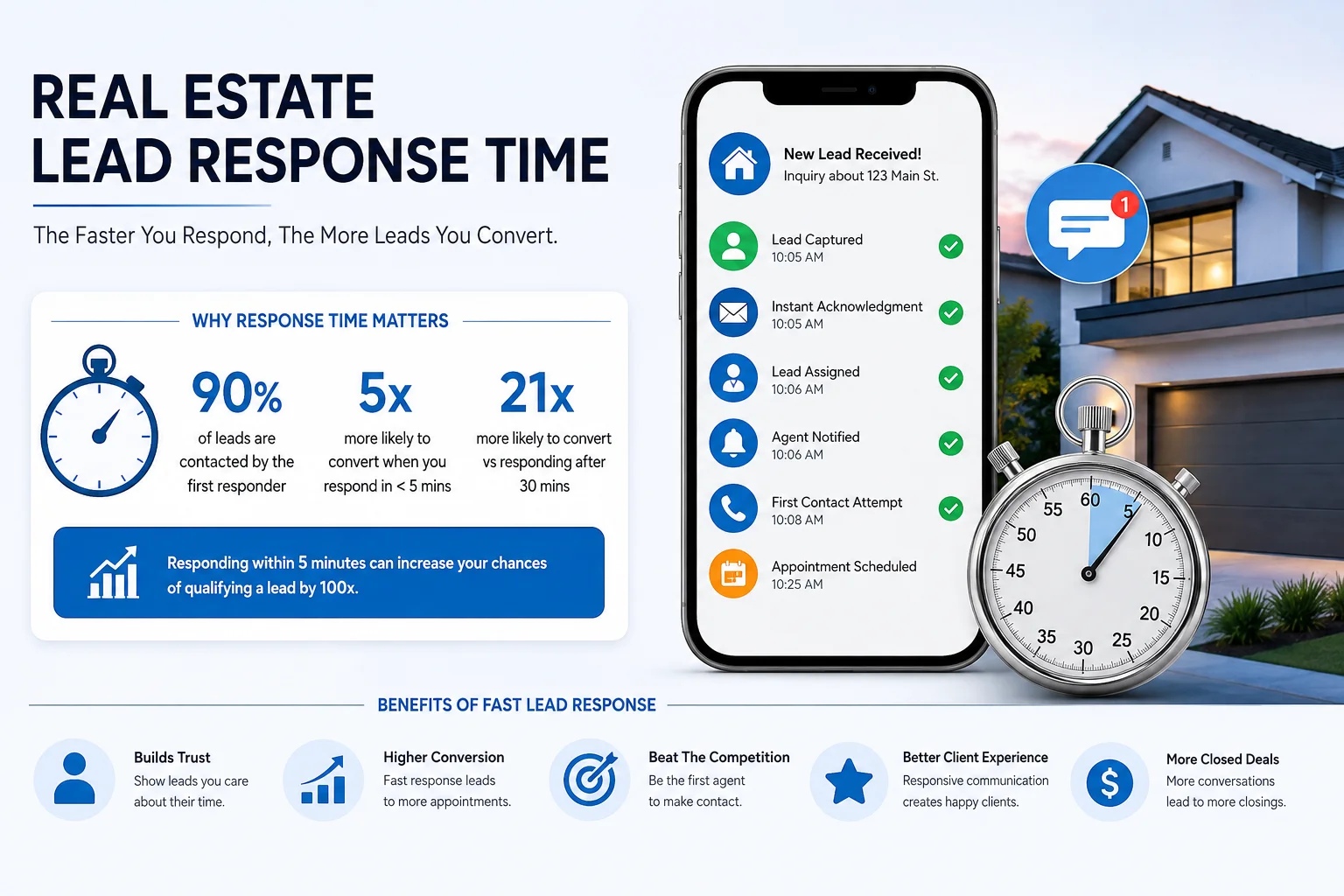
What Is Real Estate Lead Response Time?
Real estate lead response time is the amount of time between a prospect showing interest and receiving the first meaningful response from the real estate business.
For example, imagine a buyer submits a website form at 10:05 AM asking about a property.
If the agent calls at 10:10 AM, the response time is five minutes.
If the agent notices the inquiry at 3:00 PM and calls then, the response time is almost five hours.
That difference matters because the prospect’s attention and intent can change during that period.
A good real estate lead response system therefore focuses on three things:
Capturing the inquiry immediately
Acknowledging the prospect quickly
Getting a human involved as soon as possible
This is different from simply sending an automated message. A workflow can acknowledge a lead instantly, but a real sales conversation still requires an appropriate human response when needed.
Why Real Estate Lead Response Time Matters
The problem with slow real estate lead response time is not simply that an agent takes longer to reply.
The bigger problem is that the lead may continue searching while waiting.
A buyer might submit an inquiry to three agents within a few minutes. The first agent who provides a useful response may become the person the buyer continues talking to.
NAR has published material showing how quickly responding to leads can influence qualification and conversion, including a case example where rapid response was a central part of the agent’s lead-handling process.
That is why speed-to-lead should be treated as a process metric rather than just an individual agent habit.
Your goal should not simply be:
“We need our agents to answer faster.”
Instead, the goal should be:
“Our system should make it difficult for a new lead to sit untouched.”
That small change in thinking can completely change the way a real estate lead management system is designed.
9 Ways to Improve Real Estate Lead Response Time
1. Improve Real Estate Lead Response Time With Instant Lead Capture
The first step in improving real estate lead response time is making sure the lead enters your system immediately.
If a website inquiry goes into an email inbox and nobody notices it for two hours, the problem starts before the follow-up process even begins.
Your lead capture system should automatically collect information such as:
Name
Phone number
Email address
Buyer or seller status
Property interest
Location
Lead source
Date and time of inquiry
The lead should then be added to your CRM without requiring manual data entry.
This creates a reliable starting point for every future follow-up.
Your existing guide on real estate website visitors into leads explains the next part of this process: turning website traffic into identifiable prospects instead of allowing anonymous visitors to leave without an opportunity for follow-up.
2. Improve Real Estate Lead Response Time With Immediate Acknowledgment
An immediate acknowledgment is not the same as a sales pitch.
If someone submits a form asking for information about a property, the first message could simply confirm that the inquiry was received.
For example:
“Thanks for reaching out about the property. We’ve received your request and someone from our team will follow up shortly.”
This gives the prospect confidence that the inquiry did not disappear.
The message can also provide a useful next step, such as a calendar link, property guide, or basic information about the listing.
The National Association of REALTORS® has specifically discussed using quick response templates to help agents respond faster while still maintaining useful communication.
3. Improve Real Estate Lead Response Time With Lead Routing
A lead should not simply enter a CRM and wait.
It should be assigned to the correct person.
For example:
Buyer lead → Buyer specialist
Seller lead → Listing specialist
High-value inquiry → Senior agent
After-hours inquiry → Automated response + next-day task
This type of routing reduces the amount of time spent deciding who should respond.
For larger teams, routing can also be based on location, property type, lead source, language, price range, or agent availability.
Automation platforms commonly use automated assignment and notifications to reduce the delays caused by manual lead distribution.
4. Improve Real Estate Lead Response Time With a Speed-to-Lead Workflow
A strong real estate lead response time workflow should define exactly what happens after a new inquiry.
A simple workflow could look like this:
New lead enters CRM
↓
Instant acknowledgment
↓
Lead assigned to agent
↓
Agent notification
↓
First call or personal message
↓
Qualification
↓
Follow-up sequence
↓
Appointment or property viewing
This prevents the CRM from becoming nothing more than a contact database.
The system should tell the team what action needs to happen next.
This connects directly with your article on real estate follow-up automation, where you explain how structured follow-up can help agents stay consistent after a lead enters the system.
5. Improve Real Estate Lead Response Time With Lead Qualification
Speed is important, but speed alone does not guarantee conversion.
An agent also needs to understand whether the lead is actually ready to move forward.
Useful qualification questions can include:
Are you buying or selling?
What type of property are you looking for?
Which area are you interested in?
What is your approximate budget?
When are you planning to move?
Have you already spoken with another agent?
Are you ready to schedule a viewing?
Your real estate lead qualification guide already covers this stage in more detail.
The key is to connect qualification with response time.
A fast response should not be a generic message sent to everyone.
It should start a conversation that helps determine what the prospect actually needs.
6. Improve Real Estate Lead Response Time With Automated Follow-Up
Not every prospect will answer the first call.
That does not automatically mean the lead is lost.
A lead might be:
At work
Driving
Comparing properties
Waiting for financing
Talking with a spouse
Not ready to make a decision
Simply busy
This is where automated follow-up becomes useful.
For example:
Day 0: Immediate acknowledgment
Day 0: Personal call
Day 1: Helpful follow-up message
Day 3: Property-related information
Day 5: Question about their requirements
Day 7: Appointment invitation
The exact sequence should depend on your audience and communication preferences.
The purpose is not to spam the prospect.
The purpose is to make sure a legitimate inquiry does not disappear simply because the first attempt did not receive a response.
HubSpot similarly describes lead follow-up automation as a way to maintain consistent prospect engagement and prevent leads from falling through the cracks.
7. Improve Real Estate Lead Response Time With After-Hours Automation
One of the biggest weaknesses in manual follow-up is that real estate inquiries do not only arrive during business hours.
Someone may search for a property at 9:30 PM, submit an inquiry at 6:00 AM, or request information during a weekend.
You cannot expect an agent to personally respond immediately every time.
Instead, build an after-hours workflow.
For example:
New inquiry at 9:45 PM
→ Instant acknowledgment
→ Lead added to CRM
→ Agent receives notification
→ Automated message provides the next step
→ Follow-up task scheduled for the next available working period
This creates a much better experience than allowing the inquiry to sit in an inbox until the next morning.
The important distinction is that automation should support the agent, not pretend to be the agent.
8. Improve Real Estate Lead Response Time by Tracking the Right Metrics
If you want to improve real estate lead response time, you need to measure it.
At minimum, track:
Average response time
Median response time
Percentage contacted within 5 minutes
Percentage contacted within 15 minutes
Uncontacted leads
Lead-to-conversation rate
Conversation-to-appointment rate
Appointment-to-client rate
Follow-up completion rate
Average response time alone can sometimes hide problems.
For example, an average of 20 minutes might sound reasonable.
But imagine:
70% of leads → contacted within 5 minutes
30% of leads → contacted after 60 minutes
The average could still look acceptable while a significant group is being contacted too late.
That is why measuring response-time distribution can provide a better picture of your sales process.
9. Improve Real Estate Lead Response Time With One Connected CRM
The final step is connecting lead capture, communication, qualification, appointments, and follow-up into one workflow.
When an agent uses:
One tool for website forms
Another for email
Another for SMS
A spreadsheet for lead tracking
A calendar for appointments
Another tool for reminders
it becomes easy for information to get lost.
A connected CRM can bring these activities together.
For agents interested in automation, GoHighLevel is one platform that can be evaluated for combining CRM, workflows, communication, pipeline management, and appointment-related processes.
CTA placement suggestion: after explaining the complete workflow, add your own GoHighLevel affiliate/free-trial link here rather than placing an affiliate link randomly inside the article.
Want to build a real estate lead response system that follows up automatically? Try the CRM and automation platform I recommend for building lead capture, follow-up workflows, pipelines, and appointment systems.
[Start Your Free Trial → YOUR GHL AFFILIATE LINK]
Use your actual affiliate URL in place of the placeholder above. Do not use a guessed or generic affiliate URL.
Real Estate Lead Response Time and Lead Nurturing Work Together
Fast response gets the conversation started.
Nurturing keeps the relationship alive.
These are two different stages of the same system.
For example, a buyer may respond immediately after submitting an inquiry and then disappear for two weeks.
If the CRM only handles the initial response, the opportunity may still be lost.
That is why real estate lead response time should connect to a longer nurturing process.
Your article on real estate lead nurturing automation can be used here as the next step for readers who want to understand how to continue communication after the initial response.
A simple funnel can look like:
Lead Capture
→ Fast Response
→ Qualification
→ Nurturing
→ Reactivation
→ Appointment
→ Client
This also connects naturally with your real estate lead reactivation guide, especially for prospects who did not convert during the initial follow-up period.
Real Estate Lead Response Time Should Not Mean Robotic Communication
There is an important difference between automation and impersonal communication.
Automation should handle repetitive tasks such as:
Sending confirmations
Creating tasks
Assigning leads
Sending reminders
Updating pipeline stages
Starting follow-up sequences
Alerting agents
The agent should handle situations that require judgment, empathy, negotiation, or detailed property advice.
For example, an automated message can say:
“Thanks for requesting information about this property. What would you like to know first?”
But once the prospect replies:
“I’m moving from California and need to know whether this neighborhood is good for families.”
a human conversation becomes much more valuable.
The best real estate automation systems therefore combine speed with human involvement.
Real Estate Lead Response Time and Website Conversion
Improving response time is only useful if your website actually captures the visitor.
Your 7 Smart Ways to Turn Real Estate Website Visitors Into Leads article covers this earlier part of the funnel.
The complete journey should look like:
Website visitor
→ Lead capture
→ Immediate response
→ Qualification
→ Nurturing
→ Reactivation
→ Appointment
This is why your six existing articles work well as a topical cluster.
You are not writing random real estate articles.
You are building a content system around the journey from visitor → lead → qualified prospect → nurtured lead → appointment.
Real Estate Lead Response Time Checklist
Before considering your lead response process complete, check whether your system can answer these questions:
Does every website inquiry enter the CRM automatically?
Is the lead assigned to the correct person?
Does the prospect receive an immediate acknowledgment?
Does the assigned agent receive an instant notification?
Is there a clear first-contact task?
Are buyer and seller leads handled differently?
Are unresponsive leads automatically followed up?
Is there an after-hours workflow?
Can the team see which leads were never contacted?
Can you measure response time?
Can you track appointments generated from leads?
Can you identify which lead sources generate qualified prospects?
If several answers are “no,” your problem may not be a lack of leads.
It may be the system that handles the leads after they arrive.
Final Thoughts on Real Estate Lead Response Time
Real estate lead response time is one of the most practical areas for real estate businesses to improve because it directly affects what happens immediately after a prospect raises their hand.
Generating more traffic can help.
Generating more leads can help.
But if new inquiries sit unanswered, increasing lead volume can simply create a larger list of missed opportunities.
A better approach is to build a system that captures every inquiry, acknowledges it quickly, routes it correctly, qualifies the prospect, alerts the right agent, and continues follow-up when the first attempt does not produce a conversation.
The goal is not to replace real estate agents with automation.
The goal is to give agents a system that makes sure the right lead gets the right response at the right time.
When fast response, qualification, nurturing, and reactivation work together, your CRM becomes more than a database.
It becomes a lead-conversion system.
And for real estate businesses competing for attention in a crowded market, that difference can be significant.
Related Real Estate Guides
How to Generate High-Quality Real Estate Leads Without Paid Ads
7 Smart Ways to Turn Real Estate Website Visitors Into Leads
External Resources
For additional context on lead response and real estate marketing, readers can also explore resources from [the National Association of REALTORS®] and [HubSpot’s lead-response guidance]. The NAR resources discuss quick-response communication in real estate, while HubSpot explains why reducing response delays and automating lead assignment can improve sales responsiveness.
Pingback: Real Estate Appointment Booking Automation: Powerful 20+ Lead System - The autoscale agency