
Table of Contents
Introduction
Getting people to visit your real estate website is a great start.
But traffic alone doesn’t create appointments.
A potential buyer can find your blog through Google, read an article, look around your website for a few minutes, and leave without ever contacting you.
That doesn’t necessarily mean the visitor wasn’t interested.
They may simply not have been ready to talk to a Realtor yet.
This is why real estate website visitors into leads is an important part of an effective online marketing strategy.
Your goal shouldn’t be to force every visitor to book a call immediately.
Instead, you want to create a simple path that allows visitors to take the next step when they are ready.
That path can look like this:
Google Search → Blog Post → Helpful Resource → Lead Capture → Follow-Up → Conversation → Appointment
Your previous organic lead-generation strategy helps attract people through SEO, local content, educational articles, and other channels.
Now it’s time to focus on what happens after they arrive.
Why Real Estate Website Traffic Doesn’t Automatically Become Leads
Many Realtors focus heavily on getting more website visitors.
More traffic sounds good.
But imagine two websites.
Website A
Gets 2,000 visitors every month but only a few people contact the Realtor.
Website B
Gets 700 visitors but has a clear lead capture system and consistently turns interested visitors into conversations.
Which website is more valuable?
The answer isn’t always the website with more traffic.
A smaller amount of qualified traffic can be more valuable when the website gives visitors a clear reason to take action.
This is why website conversion deserves as much attention as traffic generation.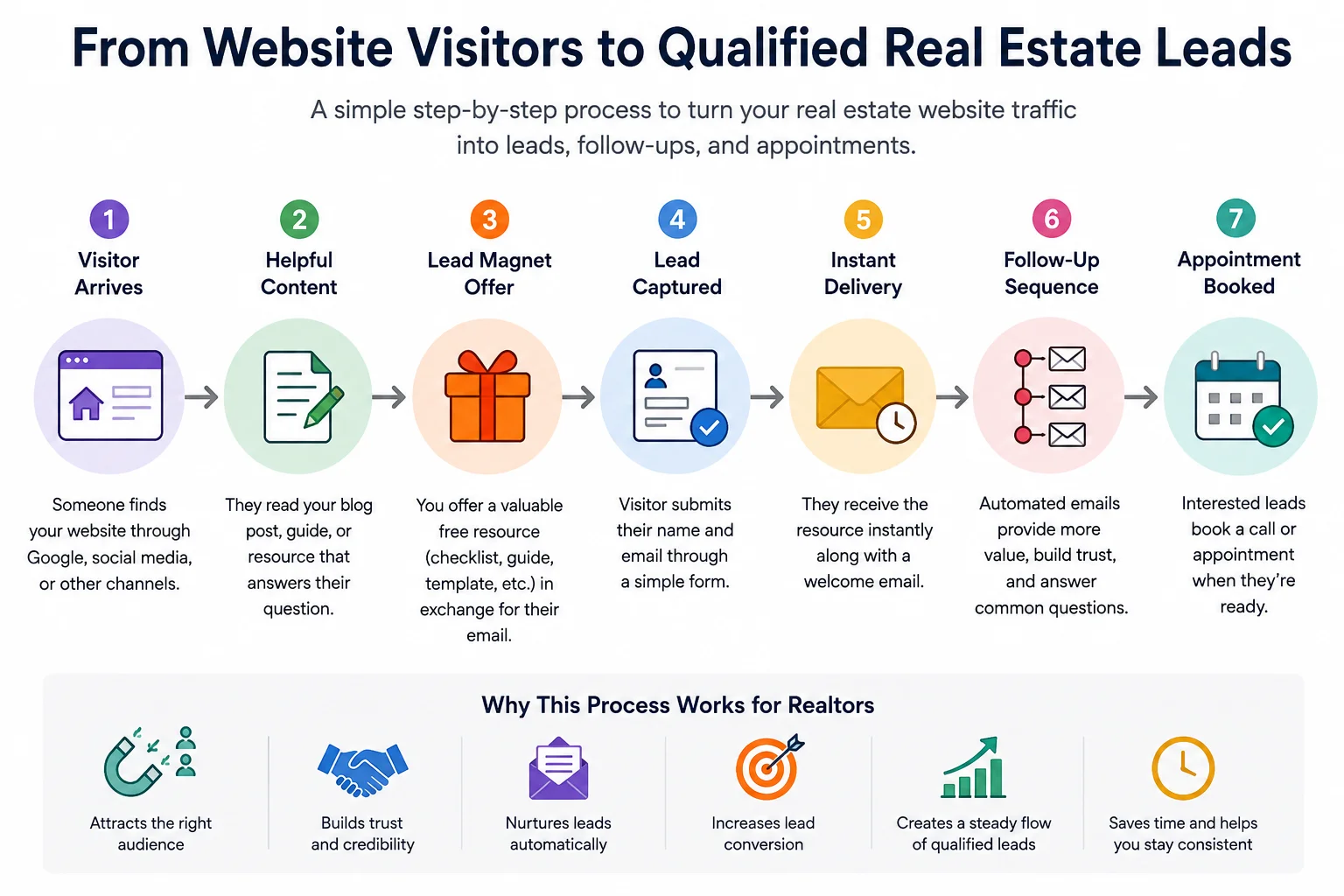
1. Create a Clear Next Step for Every Visitor
The first step in converting real estate website visitors into leads is making the next action obvious.
Don’t make visitors search through your website to figure out what they should do.
Your page should answer three simple questions:
Who is this for?
What problem does it solve?
What should I do next?
For example, a blog post about selling a house could have a CTA such as:
“Download the Home Seller Preparation Checklist.”
A first-time buyer article could offer:
“Get the First-Time Home Buyer Checklist.”
A neighborhood article could offer:
“Download the Local Buyer Guide.”
The CTA should naturally connect with the visitor’s reason for being on the page.
This is much more effective than putting the same generic “Contact Me” button everywhere.
Why Relevant CTAs Work Better
Imagine someone is reading:
“How to Prepare Your Home Before Selling.”
At the end of the article, you offer:
“Download a simple home-selling preparation checklist.”
That makes sense.
The visitor is already thinking about selling.
You’re simply giving them a practical tool to continue.
This creates a natural transition from:
Information → Interest → Action
That’s the foundation of effective real estate website lead capture.
2. Use a Simple Lead Magnet
Not every website visitor is ready to book an appointment.
Some are still researching.
Some are comparing Realtors.
Some are months away from making a decision.
Instead of losing those visitors completely, offer something useful in exchange for their contact information.
This is called a lead magnet.
A Realtor doesn’t need to create a 100-page ebook.
A simple PDF can be enough.
Examples:
- First-Time Home Buyer Checklist
- Home Seller Preparation Checklist
- Moving Day Checklist
- Home Viewing Questions Checklist
- Seller Listing Preparation Guide
- Neighborhood Research Checklist
- Home Buying Mistakes Checklist
The best lead magnet solves one specific problem.
Don’t try to solve everything in one document.
If someone searches for information about preparing their home for sale, a simple seller checklist can be more relevant than a generic “Ultimate Real Estate Guide.”
3. Match the Lead Magnet to Search Intent
This is one of the easiest ways to improve your real estate website conversion.
Your offer should match the visitor’s intent.
For example:
Blog Topic
How to Prepare Your House for Sale
Lead Magnet
Home Seller Preparation Checklist
Blog Topic
First-Time Home Buyer Mistakes
Lead Magnet
First-Time Buyer Checklist
Blog Topic
Questions to Ask Before Buying a House
Lead Magnet
Home Viewing Question Sheet
The visitor doesn’t feel like they’re being sold something unrelated.
Instead, your resource feels like the natural next step.
This is particularly useful for organic traffic because search visitors often arrive with a specific question or problem.
4. Keep Your Lead Capture Form Short
One of the biggest mistakes in lead generation is asking for too much information too early.
Imagine someone wants a free PDF.
They click the button and see a form asking for:
- Full name
- Phone number
- Address
- Property value
- Budget
- Buying timeline
- Employment information
- Several other questions
Many visitors will simply leave.
Start simple.
For a basic resource, something like:
Name
may be enough.
Once someone becomes a lead, you can learn more about them through follow-up conversations.
The purpose of the first form isn’t to collect their entire life story.
It’s to create a low-friction first interaction.
5. Follow Up Before the Lead Goes Cold
Getting someone’s email address isn’t the end of the process.
It’s the beginning.
Suppose a potential buyer downloads your checklist.
If you don’t contact them for several days, they may have already forgotten about your website.
A simple automated follow-up can prevent this.
For example:
Email 1 — Immediately
Deliver the requested resource.
Email 2 — Next Day
Share one useful buyer tip.
Email 3 — A Few Days Later
Answer a common question first-time buyers ask.
Email 4
Share another useful resource.
Email 5
Invite them to ask a question or speak with you.
Notice something important.
The emails aren’t constantly saying:
“Book a call.”
Instead, they’re building familiarity and trust.
When the person eventually needs a Realtor, your name is more likely to be remembered.
6. Use Automation to Handle Repetitive Follow-Up
This is where a real estate lead follow-up automation system becomes useful.
A solo Realtor has many things to manage:
- Property showings
- Client calls
- Negotiations
- Listings
- Inspections
- Paperwork
- Appointments
- Existing clients
Manually remembering every website lead can become difficult.
Automation can handle repetitive tasks such as:
- Sending a welcome email
- Delivering a PDF
- Sending scheduled follow-ups
- Reminding you about a lead
- Moving contacts through pipeline stages
- Triggering appointment reminders
The technology should support the Realtor rather than replace the Realtor.
The human conversation still matters.
Automation simply makes sure opportunities aren’t forgotten.
For Realtors looking for an all-in-one CRM and automation platform, GoHighLevel is one option worth researching because it combines CRM, funnels, forms, workflows, appointments, and communication tools.
7. Make the Journey From Lead to Appointment Simple
A visitor shouldn’t have to navigate through five different pages before contacting you.
The process should be simple.
A basic system can look like this:
Step 1 — Visitor finds your article
↓
Step 2 — Visitor sees relevant resource
↓
Step 3 — Visitor submits simple form
↓
Step 4 — Resource is delivered
↓
Step 5 — Automated follow-up begins
↓
Step 6 — Visitor asks a question or shows buying/selling intent
↓
Step 7 — Appointment opportunity
This is the basic structure behind a strong real estate lead conversion strategy.
You don’t need a complicated funnel to start.
You need a clear one.
How AI Can Improve Real Estate Lead Conversion
AI can also support this process.
For example, AI can help a Realtor create:
- Follow-up email drafts
- Buyer FAQ content
- Seller FAQ content
- Lead qualification questions
- Blog topics
- Social media content
- Personalized follow-up ideas
- Appointment reminder messages
But AI shouldn’t make your communication sound robotic.
The best approach is:
AI handles repetitive content work.
The Realtor provides the human expertise.
This combination can make the system faster while keeping the experience personal.
For example, instead of sending every lead the same generic message, you can create different follow-up paths for:
First-time buyers
Move-up buyers
Home sellers
Investors
Local relocation prospects
The content becomes more relevant without requiring the Realtor to manually write every message.
Don’t Try to Convert Every Visitor Immediately
This is an important point.
A person searching:
“How much does it cost to sell a house?”
may not be ready to hire a Realtor today.
Trying to force them into a consultation immediately can create unnecessary friction.
Instead, give them useful information.
Then offer a relevant resource.
Then continue the relationship.
Over time, their intent may change.
Today’s researcher can become tomorrow’s seller.
That’s why lead nurturing matters.
The goal is not:
Visitor → immediate sale
The goal is:
Visitor → relationship → trust → conversation → opportunity
Track the Right Numbers
You don’t need to obsess over dozens of analytics metrics.
Start with a few important numbers.
Website Visitors
How many people are reaching your website?
Lead Conversion Rate
How many visitors become leads?
Lead Source
Where are your leads coming from?
- Social media
- Referral
- Direct traffic
Lead Quality
Are the leads actually relevant?
Appointment Rate
How many leads become conversations or appointments?
These numbers help you understand where the problem is.
For example:
If traffic is low → improve SEO/content.
If traffic is high but leads are low → improve conversion.
If leads are high but appointments are low → improve follow-up.
If appointments are high but clients are low → examine qualification and sales conversations.
This is much better than simply saying:
“I need more traffic.”
A Simple Example
Imagine a Realtor gets:
1,000 website visitors
Suppose:
30 visitors download a useful resource.
Those 30 people enter a follow-up system.
Over time:
10 respond to an email.
Then:
5 start a real conversation.
And:
2 become appointments.
The numbers are only an example, not a guaranteed benchmark.
The important lesson is that your website doesn’t need every visitor to become a client.
It needs to create a reliable path for the visitors who are genuinely interested.
Common Real Estate Website Conversion Mistakes
Using Only a “Contact Me” Button
A generic contact button may not give a visitor enough reason to act.
Offer something useful.
Asking for Too Much Information
Long forms create unnecessary friction.
Start simple.
No Follow-Up System
A lead sitting inside your inbox isn’t a lead-management strategy.
Create a process.
Sending Too Many Sales Messages
People don’t want to feel chased.
Educate first.
Using the Same CTA Everywhere
Match the offer to the content.
Ignoring Mobile Visitors
A large portion of website visitors may browse from phones.
Your forms, buttons, and pages should work properly on mobile devices.
How to Build Your First Real Estate Lead Capture System
You can start with a very simple setup.
Step 1
Choose one audience.
For example:
First-time home buyers.
Step 2
Choose one problem.
For example:
They don’t know what to prepare before buying.
Step 3
Create one useful PDF.
First-Time Home Buyer Checklist
Step 4
Create one blog article.
Answer the problem in detail.
Step 5
Add one CTA.
Offer the checklist.
Step 6
Create a simple form.
Name + email.
Step 7
Set up follow-up.
Deliver the PDF and send helpful messages.
Step 8
Create an appointment option.
Give interested leads a simple way to contact you.
That’s enough to build your first real estate website lead capture system.
You can improve it later.
Frequently Asked Questions
How do I turn real estate website visitors into leads?
Create helpful content, add relevant lead magnets, use simple lead forms, and follow up consistently with visitors who provide their contact information.
What is the best way to capture real estate website leads?
A relevant lead magnet combined with a simple form is a practical starting point. The offer should match the visitor’s search intent.
How can Realtors convert website traffic into leads?
Realtors can improve website conversion by using clear CTAs, useful resources, simple forms, trust-building content, and consistent follow-up.
Can AI automate real estate lead follow-up?
AI and automation tools can help with repetitive communication, lead organization, reminders, and content creation. Human involvement is still important for meaningful client conversations.
Does every website visitor need to become a lead?
No. Some visitors are only researching. The goal is to create opportunities for interested visitors to raise their hand and stay connected until they’re ready.
Is real estate lead generation software necessary?
Not necessarily when starting. A simple website, form, email system, and clear process can work initially. As lead volume increases, a CRM and automation platform can make management easier.
Final Thoughts
Getting people to your real estate website is only the beginning.
The real opportunity starts when you create a clear path for those visitors to become contacts, conversations, and eventually clients.
Your previous organic marketing efforts can bring buyers and sellers to your website through search-focused content and local resources.
Now the next step is making sure those visitors don’t simply disappear.
Give them something useful.
Make the next step obvious.
Keep your forms simple.
Follow up consistently.
Use automation for repetitive tasks.
And keep the human conversation at the center.
You don’t need thousands of leads.
You need a system that consistently identifies the people who are genuinely interested and gives them a reason to continue the conversation.
Traffic creates opportunity.
Good lead capture creates contacts.
Consistent follow-up creates conversations.
Trust turns conversations into clients.
That is how you turn real estate website visitors into leads without relying entirely on constantly buying more traffic.
Want to Save Time Creating Real Estate Content?
Building lead-generating content doesn’t have to mean starting from a blank page every time.
I created a 30 Real Estate AI Prompt Package designed to help Realtors create better content, generate ideas faster, and stay consistent with their online marketing.
Get the free 30-prompt package and start creating smarter real estate content today.
Pingback: Real Estate Lead Routing Automation: 7 Powerful Ways to Connect Leads Faster - The autoscale agency