

Someone filled out a form.
Someone asked about a property.
Someone downloaded a guide.
Someone sent a message.
But there’s an important question that comes after getting the lead:
Is this person actually ready to have a conversation?
Not every inquiry has the same level of intent.
Some people are ready to buy.
Some are comparing properties.
Some are researching the market.
Some are interested in selling but aren’t ready yet.
And some people may have simply clicked on something because they were curious.
That doesn’t mean those leads are useless.
It means they shouldn’t all receive the same follow-up.
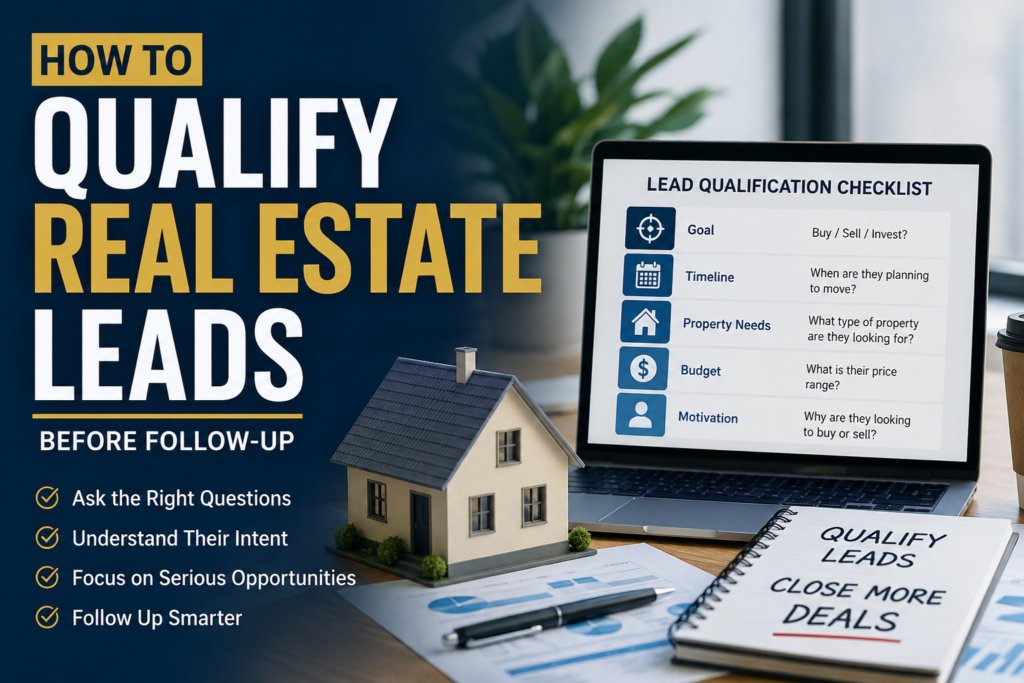
A simple real estate lead qualification process can help Realtors understand where each person is in their decision-making process and decide what should happen next.
Instead of treating every contact as an immediate sales opportunity, you can separate:
New inquiry → Potential lead → Qualified lead → Conversation → Appointment
In this article, we’ll look at nine practical ways to qualify real estate leads without making the process complicated or overly aggressive.
1. Start by Understanding Why the Person Contacted You
The first qualification signal is often the simplest one:
Why did they reach out?
For example, someone might say:
“I’m interested in this property.”
That’s different from:
“I’m planning to buy a home within the next three months.”
And that’s different again from:
“I’m just researching prices in the area.”
All three people could eventually become clients.
But they have different levels of intent.
A useful first step is to identify the reason behind the inquiry.
Common reasons include:
- Buying a home
- Selling a home
- Investment
- Property valuation
- Requesting property information
- Market research
- Relocation
- First-time home buying
This simple classification can make your follow-up much more relevant.
Instead of asking every person the same question, you can continue the conversation based on what they actually want.
2. Ask About Their Timeline
One of the most useful real estate lead qualification questions is:
“When are you hoping to make a move?”
You don’t need to make the question sound like an interrogation.
A simple version could be:
“Are you thinking about moving soon, or are you still in the research stage?”
This gives the prospect an easy way to explain their situation.
You can then roughly categorize the response:
Ready Soon
They are actively looking or preparing to sell.
Planning
They expect to make a move in the coming months.
Researching
They are gathering information and aren’t ready yet.
Unknown
You don’t have enough information yet.
This doesn’t mean you should ignore people who aren’t ready.
Instead, the follow-up frequency and message can change based on their timeline.
3. Understand Whether They’re Buying or Selling
A real estate buyer and a potential seller have completely different needs.
A buyer might need:
- Property options
- Neighborhood information
- Financing resources
- Viewing appointments
- Market information
A seller might need:
- Home preparation advice
- Pricing information
- Market data
- Listing preparation
- Valuation guidance
That’s why one of the first steps in a real estate lead qualification process should be identifying the person’s goal.
A simple question works:
“Are you currently looking to buy, sell, or just explore the market?”
That’s enough to begin.
You can then move the contact into a more relevant follow-up path.
4. Ask What They’re Looking For
If someone says they want to buy, that’s useful.
But you still don’t know what they’re actually looking for.
You can ask:
“What type of property are you mainly looking for?”
Then continue naturally:
- House?
- Condo?
- Investment property?
- Land?
- New construction?
You can also ask about:
- Preferred location
- Number of bedrooms
- Property type
- Approximate budget
You don’t need to ask everything at once.
Start with the information that will actually help you determine whether the inquiry is worth a more personalized conversation.
5. Use Budget as a Conversation Tool — Not a Pressure Question
Budget can be an important qualification signal.
But the way you ask matters.
Instead of:
“What’s your exact budget?”
you could say:
“Do you already have a price range in mind?”
That’s easier to answer.
Someone might respond:
“We’re looking around $400k–$500k.”
Now the Realtor has useful context.
But remember:
Budget alone doesn’t determine lead quality.
Someone with a smaller budget may be extremely serious.
Someone with a large budget may only be browsing.
That’s why qualification should look at several signals together.
6. Look for Intent Signals
This is where qualification becomes more interesting.
Instead of relying on one question, look at the person’s behavior.
For example:
Lower Intent
- Reads one article
- Downloads a general guide
- Doesn’t respond to messages
- Browses multiple unrelated properties
Medium Intent
- Returns to the website
- Views multiple properties
- Requests more information
- Responds to an email
Higher Intent
- Requests a property showing
- Asks about availability
- Provides buying timeline
- Asks specific transaction questions
- Wants to discuss financing or selling
- Requests a consultation
These signals can help determine what should happen next.
You don’t necessarily need a complicated AI system to start tracking them.
Even basic tags such as:
New
Researching
Interested
Qualified
Appointment
can create a much clearer pipeline.
7. Create a Simple Real Estate Lead Scoring Process
Lead scoring sounds complicated.
It doesn’t have to be.
You can create a basic scoring model.
For example:
| Lead action | Example score |
|---|---|
| Downloads general guide | +1 |
| Replies to email | +2 |
| Requests property information | +3 |
| Provides timeline | +3 |
| Requests a showing | +5 |
| Books appointment | +7 |
These numbers are only an example.
The exact scoring system should depend on the Realtor’s business.
The important idea is:
Not every action has equal intent.
A person who downloads a generic guide isn’t necessarily as ready as someone requesting a property showing.
A simple scoring model can help prioritize attention.
8. Don’t Follow Up With Every Lead the Same Way
This is where your qualification process connects directly to your existing follow-up content.
Your Real Estate Follow-Up Automation System article focuses on what happens after a lead enters the system.
Qualification helps decide which path that lead should enter.
For example:
High-Intent Buyer
New inquiry
↓
Qualification
↓
Property information
↓
Personal response
↓
Showing invitation
↓
Appointment
Researching Buyer
New inquiry
↓
Qualification
↓
Buyer resources
↓
Educational follow-up
↓
Market updates
↓
Long-term nurture
Potential Seller
Seller inquiry
↓
Qualification
↓
Seller resources
↓
Home preparation information
↓
Valuation conversation
↓
Appointment
This is much more useful than putting every contact into one giant follow-up sequence.
9. Know When a Lead Is Ready for a Human Conversation
Automation can help organize leads.
But there should be a point where the Realtor takes over.
For example, if someone says:
“I’m planning to buy next month and I’d like to see two properties this weekend.”
That’s no longer just a marketing lead.
That’s a high-intent conversation.
At this stage, continuing to send generic automated emails may actually make the experience worse.
Instead:
Automation pauses → Realtor gets notified → Personal conversation begins
This is one of the most important principles of using automation correctly.
The purpose isn’t to keep people inside an automated sequence forever.
The purpose is to identify when human involvement matters most.
A Simple Real Estate Lead Qualification Workflow
You can put the entire process into a simple system:
New Lead
↓
What are they interested in?
↓
Buyer / Seller / Investor / Researcher
↓
What is their timeline?
↓
What are they looking for?
↓
Approximate budget or property requirements
↓
Intent signals
↓
Lead score / qualification level
↓
Relevant follow-up
↓
Human conversation when ready
This creates a much clearer process for handling new inquiries.
Example: Qualifying a Buyer Lead
Imagine a Realtor receives this inquiry:
“Hi, I’m interested in the 3-bedroom property you listed.”
Instead of immediately sending a generic:
“Thanks for contacting me!”
the Realtor could ask:
“Thanks for reaching out. Are you currently looking to move soon, or are you still exploring options?”
The buyer responds:
“We’re hoping to move within the next two months.”
Now you know something important.
You could continue:
“Great. Are you mainly looking for a 3-bedroom home in this area, or are you open to nearby neighborhoods too?”
Now the Realtor understands:
Property interest + timeline + location preference
That’s already much more useful than simply having a name and phone number.
Example: Qualifying a Seller Lead
A seller might say:
“I’m thinking about selling my house.”
Instead of immediately sending a sales pitch, ask:
“Are you thinking about selling soon, or are you mainly trying to understand what your home could be worth?”
If they respond:
“We’re considering selling within the next three months.”
That’s a much stronger intent signal.
Now the Realtor can move the conversation toward:
- Property preparation
- Market conditions
- Valuation
- Selling timeline
- Consultation
The conversation becomes more relevant because the Realtor understands the person’s situation.
What If the Lead Isn’t Ready?
This is important.
Not ready doesn’t mean not valuable.
Someone who says:
“I’m probably going to buy next year.”
shouldn’t automatically be deleted.
Instead, they can enter a longer nurture process.
For example:
Quarterly market updates
Useful buyer guides
Neighborhood information
New property alerts
Educational content
Then, when their timeline changes, they already know who to contact.
This is where your existing automated follow-up system can become useful.
How Lead Qualification Connects With Your Website
Your previous article about turning real estate website visitors into leads focuses on converting anonymous visitors into contacts.
But there’s another step after that.
Think about the complete journey:
↓
Website Visitor
↓
Useful Content
↓
Lead Capture
↓
Lead Qualification
↓
Follow-Up
↓
Appointment
↓
Client
Each stage has a different purpose.
That’s why your website shouldn’t be judged only by how many visitors it receives.
You also want to understand:
Who are those visitors?
Why did they contact you?
How serious are they?
What should happen next?
Don’t Make Qualification Feel Like a Form
One of the biggest mistakes is turning qualification into a long questionnaire.
Imagine a visitor sees:
Name
Phone
Budget
Location
Employment
Financing
Timeline
Property Type
Bedrooms
Purpose
Motivation
They may simply leave.
Instead, qualification can happen during the conversation.
Start with one question.
Then ask the next question based on their answer.
That feels much more natural.
It’s the difference between:
“Fill out this form.”
and:
“Tell me a little about what you’re looking for.”
5 Qualification Questions Realtors Can Start Using
If you want to keep the process simple, start with these:
1. What are you looking to do?
Buy, sell, invest, or research?
2. What’s your approximate timeline?
Soon, several months, or just researching?
3. What type of property are you interested in?
House, condo, investment property, etc.
4. Do you already have a price range in mind?
This gives you budget context.
5. What would you like help with right now?
This is often the most useful question.
It lets the prospect tell you what they actually need.
How AI Can Help With Lead Qualification
AI can assist with the repetitive parts of qualification.
For example, an AI-assisted workflow could:
- Read the initial inquiry
- Identify buyer/seller intent
- Extract timeline information
- Tag the lead
- Summarize the conversation
- Suggest a follow-up message
- Notify the Realtor when intent is high
But AI shouldn’t make every important decision automatically.
A better model is:
AI organizes the information → Realtor makes the final judgment.
This keeps the system efficient without removing human judgment.
What Happens After Qualification?
Once a lead is qualified, the next step depends on intent.
High Intent
Move toward conversation or appointment.
Medium Intent
Continue relevant nurture.
Low Intent
Provide useful educational content.
Not a Fit
Don’t waste unnecessary sales time.
This helps Realtors spend more time on people who actually need immediate assistance while still keeping future opportunities alive.
Common Lead Qualification Mistakes
Treating Every Lead as Equal
Different people have different levels of intent.
Asking Too Many Questions
Qualification should feel like a conversation.
Ignoring Timeline
A person buying next week and someone buying next year need different follow-up.
Focusing Only on Budget
Budget is useful, but intent and timing matter too.
Never Updating Lead Status
A lead can move from:
Researching → Interested → Qualified → Appointment
Your system should reflect that change.
Automating the Human Conversation
Automation should support the Realtor, not replace every interaction.
Final Thoughts
The goal of lead qualification isn’t to find a reason to reject people.
It’s to understand them better.
A simple process can tell you:
Who is this person?
What do they want?
When do they want it?
How serious are they?
What should happen next?
Once those questions are clear, your follow-up becomes much easier.
Instead of sending the same message to everyone, you can create a more relevant journey:
Website Visitor
→ Lead
→ Qualified Lead
→ Relevant Follow-Up
→ Conversation
→ Appointment
→ Client
And that’s where lead generation becomes more than simply collecting names and phone numbers.
It becomes a system for identifying the opportunities that deserve attention.
🎁 Want 30 Ready-to-Use AI Prompts for Your Real Estate Business?
If you’re a Realtor looking to use AI for content creation, marketing, lead follow-up, client communication, and everyday tasks, I’ve put together a 30 AI Prompt Pack for Real Estate Businesses.
Instead of starting from a blank AI chat every time, you can use ready-to-adapt prompts for common real estate tasks.
Pingback: Real Estate Open House Follow Up Automation: The 2026 Guide to Never Losing a Valuable Lead - The autoscale agency
Pingback: Real Estate Appointment Booking Automation: Powerful 20+ Lead System - The autoscale agency
Pingback: Real Estate Lead Routing Automation: 7 Powerful Ways to Connect Leads Faster - The autoscale agency