
Table of Contents
Introduction
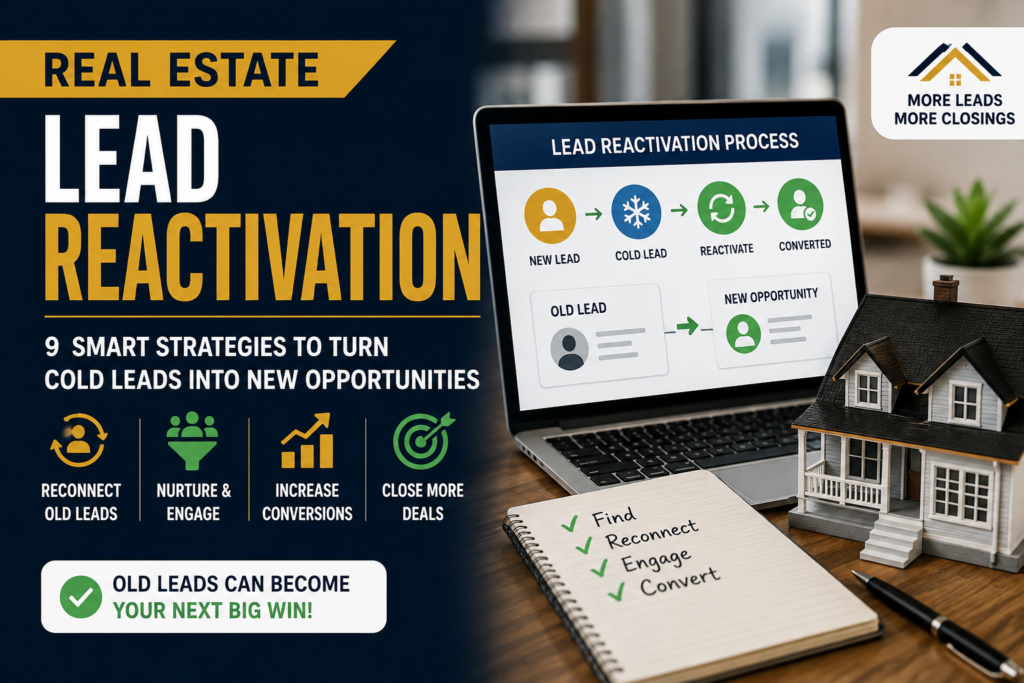
Real estate lead reactivation can help Realtors reconnect with old leads, restart conversations, and identify new opportunities that may otherwise be forgotten.
They run ads.
They publish content.
They collect website inquiries.
They receive property questions through social media.
But there is another source of opportunities that many Realtors overlook:
The leads they already have.
A CRM may contain hundreds or even thousands of contacts who previously showed interest in buying, selling, investing, or learning about the market.
Some of them never responded.
Some were not ready at the time.
Some stopped replying after the first conversation.
And some simply disappeared because their timeline changed.
That doesn’t necessarily mean those leads are worthless.
Their situation may have changed.
Someone who wasn’t ready to buy six months ago could now be actively looking.
A homeowner who was only researching a possible sale last year may now be ready to speak with an agent.
The challenge is knowing how to re-engage these contacts without sending random sales messages.
A good reactivation process can help Realtors reconnect with older leads, understand their current situation, and identify which conversations are worth pursuing.
If you’re already working on lead generation, qualification, and follow-up, lead reactivation is the next important piece of the system.
1. Why Real Estate Lead Reactivation Starts With Understanding the Lead
Before sending a message, understand why the conversation stopped.
There are many possible reasons.
The person may have:
- Changed their buying timeline
- Decided not to move
- Started working with another Realtor
- Needed more time
- Been researching the market
- Stopped responding
- Changed their budget
- Lost interest in a particular property
- Become interested in a different location
This is important because a cold lead is not always a bad lead.
Sometimes the timing was simply wrong.
That’s why the first step should be understanding the previous interaction before trying to restart the conversation.
2. Separate Old Leads Into Different Groups
One of the biggest mistakes is treating every old contact exactly the same.
A person who requested a property showing six months ago should not receive the same message as someone who downloaded a general real estate guide.
You can create simple groups such as:
Previous High-Intent Leads
These people previously:
- Requested a showing
- Asked about availability
- Discussed financing
- Asked about selling
- Requested a consultation
- Had an active conversation
- A well-planned real estate lead reactivation strategy helps Realtors prioritize older contacts.
Medium-Intent Leads
These people may have:
- Requested property information
- Replied to emails
- Viewed multiple listings
- Asked general questions
- Engaged with real estate content
Low-Intent Leads
These contacts may have:
- Downloaded a guide
- Filled out a general form
- Visited the website
- Shown limited engagement
The goal isn’t to delete low-intent leads.
The goal is to reactivate them differently.
3. Don’t Start With a Sales Pitch
This is one of the most important rules of lead reactivation.
Imagine someone hasn’t spoken to you for eight months.
Then suddenly they receive:
“Hi, are you ready to buy a property? Book a call today.”
That feels like a sales pitch.
Instead, restart the conversation naturally.
For example:
“Hi Sarah, we spoke a while back about your plans to move. Just checking in — are you still considering a move, or has your timeline changed?”
That’s much easier to respond to.
You’re not immediately asking for a meeting.
You’re simply asking for an update.
4. Use Their Previous Context
Your old conversations contain valuable information.
If someone previously mentioned:
- A specific neighborhood
- Property type
- Budget range
- Buying timeline
- Selling plans
- Number of bedrooms
- Investment goals
use that context when restarting the conversation.
For example:
“Last time we spoke, you were looking for a 3-bedroom home around Miami. Are you still looking in that area?”
This feels completely different from a generic broadcast message.
The prospect can see that you actually remember the conversation.
5. Give the Lead a Reason to Respond
Sometimes people don’t respond because there’s nothing interesting to respond to.
Instead of simply saying:
“Just checking in.”
give them something useful.
For example:
“I noticed there have been some changes in the local market since we last spoke. Are you still considering buying this year?”
Or:
“A few properties similar to what you were looking for have recently come onto the market. Are you still interested in that type of property?”
The message should create a natural reason for the person to answer.
6. Use Different Reactivation Messages for Buyers and Sellers
Buyers and sellers have different motivations.
For an old buyer lead:
“Hi John, when we last spoke you were exploring homes in the area. Are you still looking, or has your timeline changed?”
For an old seller lead:
“Hi John, last time we spoke you were considering selling your property. Are you still thinking about selling, or are you holding off for now?”
For a long-term researcher:
“Hi John, you were researching the local market a while back. Are you still keeping an eye on properties, or has your plan changed?”
The goal is simple:
Start a conversation, not a sales sequence.
7. A good real estate lead reactivation process should connect with your existing CRM and follow-up system.
Lead reactivation shouldn’t exist as a completely separate process.
It should connect with your existing lead management system.
Your earlier guide on how to qualify real estate leads explains how Realtors can identify intent, timeline, property needs, and qualification level.
That qualification information becomes extremely useful when you’re reactivating older contacts.
A simple system could look like:
Old Lead
↓
Previous conversation
↓
Current intent check
↓
Buyer / Seller / Investor
↓
Timeline
↓
Current interest
↓
Lead score
↓
Reactivated / Nurture / Not interested
↓
Relevant follow-up
This prevents the CRM from becoming a database full of forgotten contacts.
Connecting real estate lead reactivation with your CRM makes the follow-up process more organized.

8. Website activity can provide useful signals during real estate lead reactivation
Another useful signal is what the lead is doing now.
Someone who was inactive for six months but suddenly:
- Visits your website
- Reads multiple articles
- Views properties
- Downloads a guide
- Returns to a landing page
- Replies to an email
may be showing renewed interest.
Your earlier article on turning real estate website visitors into leads covers the importance of turning website activity into identifiable opportunities.
The next step is connecting that activity with the CRM.
For example:
Old Contact
→ Returns to website
→ Views property content
→ Downloads guide
→ Lead status changes
→ Reactivation message
→ Conversation
This creates a much stronger system than simply sending the same message to every old contact.
9.AI can make real estate lead reactivation easier when a Realtor has hundreds of inactive contact
For example, an AI-assisted workflow can help:
- Identify old inactive contacts
- Summarize previous conversations
- Identify previous buying or selling intent
- Extract timeline information
- Categorize leads
- Suggest personalized reactivation messages
- Detect new engagement
- Notify the Realtor when someone responds
- Recommend the next follow-up step
But AI shouldn’t replace the human conversation.
A better model is:
AI identifies the opportunity → AI prepares the context → Realtor starts the important conversation.
This keeps the system efficient without making every interaction feel automated.
AI can make real estate lead reactivation faster by identifying inactive contacts and preparing personalized messages.
A Simple Real Estate Lead Reactivation Workflow
Here’s a simple example:
Old Lead
↓
No activity for 90+ days
↓
Review previous conversation
↓
Identify buyer / seller / investor
↓
Check previous intent
↓
Send personalized reactivation message
↓
Lead responds
↓
Re-qualify the lead
↓
Update CRM status
↓
Relevant nurture or follow-up
↓
Human conversation
↓
Appointment
↓
Client
This is where lead reactivation connects with your existing automation strategy.
Your article on automating real estate lead follow-up using GoHighLevel can fit naturally here because the CRM and automation layer can handle much of the repetitive work.
What If the Lead Doesn’t Respond?
Not every reactivation message will get a response.
That’s normal.
You shouldn’t keep sending messages every few days.
Instead, create a longer-term nurture process.
For example:
Month 1
Personal reactivation message.
Month 2
Useful market update.
Month 3
Relevant buyer or seller resource.
Month 4
Local market insight.
Month 5
New property or market opportunity.
Month 6
Another personal check-in.
The exact timing should depend on the lead’s situation.
The objective isn’t to chase someone forever.
It’s to remain useful enough that when their situation changes, your name is still familiar.
Why Lead Reactivation Can Be More Efficient Than Starting From Zero
Generating a brand-new lead requires several steps.
You need to:
- Reach the person
- Get their attention
- Build awareness
- Capture their information
- Understand their needs
- Build trust
- Start the conversation
With an existing lead, some of that work has already happened.
They already know who you are.
They may have already visited your website.
They may have already discussed a property.
They may have already asked questions.
That doesn’t mean they’re guaranteed to become clients.
But it does mean there is already some context.
That’s why a well-organized reactivation strategy can complement new lead generation.
Your earlier guide on generating high-quality real estate leads without paid ads focuses on bringing new opportunities into the pipeline.
Lead reactivation focuses on making sure older opportunities aren’t simply forgotten.
Common Lead Reactivation Mist
Sending the Same Message to Everyone
akes
A buyer, seller, investor, and researcher shouldn’t receive identical messages.
Making the First Message Too Promotional
The first goal is to restart the conversation.
Not close the deal immediately.
Ignoring Previous Context
If you already know what the person was looking for, use that information.
Reactivating Leads Without Updating the CRM
If someone responds, their status should change.
Otherwise, the same person may continue receiving irrelevant automation.
Over-Automating the Conversation
Automation should help identify and organize opportunities.
It shouldn’t make every conversation sound robotic.
The Bigger Picture
Real estate lead generation doesn’t end when someone enters your CRM.
The complete journey can look like:
Google / Social / Content
↓
Website Visitor
↓
Lead
↓
Lead Qualification
↓
Follow-Up
↓
Nurture
↓
Lead Reactivation
↓
Conversation
↓
Appointment
↓
Client
Every stage has a different purpose.
That’s why successful real estate automation isn’t about sending more messages.
It’s about knowing what should happen next for each lead.
Some leads need immediate follow-up.
Some need qualification.
Some need education.
Some need long-term nurturing.
And some simply need a well-timed message months after the original conversation.
The goal is not to treat every contact like a new lead.
The goal is to build a system that remembers the opportunity.
Final Thoughts
Your CRM shouldn’t be a graveyard of old contacts.
Every inactive lead represents a previous conversation, an earlier interest, or a potential future opportunity.
The right reactivation strategy can help Realtors understand:
- Who was previously interested?
- What were they looking for?
- Why did the conversation stop?
- Has their situation changed?
- Are they showing new intent?
- What should happen next?
When those questions are connected to qualification, follow-up, CRM automation, and human conversations, the process becomes much more powerful.
You don’t need to chase every old lead.
You need a system that knows which ones are worth talking to again.
The goal of real estate lead reactivation is to identify which older contacts are worth reconnecting with.
Pingback: Real Estate Appointment Booking Automation: Powerful 20+ Lead System - The autoscale agency